2025 Spiritual Awakening Workbook
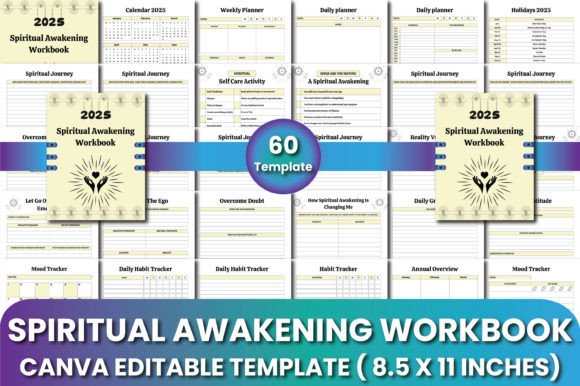
What if your spiritual growth didn’t have to happen in isolation—or in fragments scattered across apps, sticky notes, and half-filled journals? The 2025 Spiritual Awakening Workbook is a thoughtfully structured, 60-page printable resource designed for people who want depth without distraction. It’s not just a collection of prompts—it’s a living framework that meets you where you are: whether you’re noticing your first subtle shifts in awareness, deepening a long-standing practice, or supporting others on their path.
More Than Pages—A Designed Experience
This isn’t a generic journal with vague affirmations. Every page serves a purpose grounded in real spiritual development principles: witnessing the ego, distinguishing reality from illusion, releasing habitual emotional patterns, and anchoring presence through gratitude and reflection. The layout balances structure and spaciousness—enough guidance to begin, enough openness to grow into.
The workbook comes as two complementary assets: a print-ready PDF and an editable Canva link. Both are built for real-world use—not theory. The PDF is KDP-tested (8.5" × 11", CMYK, 300 DPI, no bleed), meaning it uploads cleanly to Amazon Kindle Direct Publishing if you're creating a published version. The Canva file lets you personalize colors, fonts, headers, or even reorder sections—ideal if you're adapting it for clients, students, or your own brand.
For Beginners Exploring Their First Awakening Signs
If you’ve recently felt a quiet shift—less attachment to outcomes, more sensitivity to energy, or sudden questions about identity and purpose—the 2025 Spiritual Awakening Workbook offers gentle scaffolding. Pages like “How Spiritual Awakening Is Changing Me” and “Overcome Autopilot” help name what’s unfolding without pressure to “get it right.” The daily gratitude and mood trackers build consistency without overwhelm. No prior knowledge needed—just willingness to show up honestly.
For Educators and Coaches Supporting Others
You don’t need to reinvent the wheel for every client. The workbook’s modular design means you can assign specific pages based on individual needs: “Witness The Ego” for someone struggling with reactivity, “Reality Vs Illusion” for those questioning long-held beliefs, or the “Monthly Self Care Plan” for burnout recovery. Because it’s editable in Canva, you can add your logo, tweak language for your audience, or embed your own reflection questions—all while preserving the integrity of the original framework.
For Creators, Bloggers, and Small Business Owners
Time is your most non-renewable resource. The 2025 Spiritual Awakening Workbook saves hours of design work. Use the Canva link to create branded versions for your email list, sell as a low-cost digital product, or bundle with courses and retreats. Since it’s already optimized for print (CMYK, 300 DPI, KDP-compliant), launching a physical version is streamlined—not speculative. One creator used the “Annual Overview” and “Manifestation Planner” pages to build a signature goal-setting workshop; another adapted the “Weekly Journal” into a subscriber-only reflection series.
For Professionals and Entrepreneurs Navigating High-Pressure Roles
Clarity isn’t a luxury when decisions impact teams, budgets, or reputations. The “Self Care Calendar” and “Weekly Reflection” pages help integrate presence into demanding schedules—not as another task, but as recalibration. A marketing director shared how using “Let Go Of Negative Emotions” before high-stakes meetings reduced reactive communication. Another freelancer uses the “Habit Tracker” alongside her time logs to spot patterns between energy dips and unprocessed stress.
For Hobbyists and Lifelong Learners
Spiritual practice doesn’t require a title, a temple, or a teacher. If you enjoy journaling, sketching, or quiet mornings with tea, this workbook meets that rhythm. The “Notes Files” section invites doodles, quotes, or voice memos transcribed later. The “Important Notes” page stays blank until you decide what matters—no assumptions about your beliefs, tradition, or pace. Flexibility here isn’t an afterthought—it’s built in.
What Makes the Design Work—Practically
It’s easy to overlook how much usability lives in the details:
- Calendar integration: Page 12 includes 2025 holidays—so you can plan reflection days around natural pauses in the year.
- Dual tracking: Separate “Daily Habit Tracker” and “Mood Tracker” pages let you observe correlations over time—without conflating behavior and feeling.
- No fluff, no filler: Each of the 60 pages has intentional function. Even the “To Do List” is framed as “Spiritual Alignment Tasks,” gently reinforcing intentionality.
- Print-and-go ready: Tested on KDP means no last-minute surprises—bleed-free, correct margins, consistent spacing. What you see in Canva is what prints.
Fitting It Into Your Real Life
You don’t need to start on January 1st—or finish by December 31st. Many users begin with just two pages: “Daily Gratitude” and “Weekly Reflection.” Others use the “Spiritual Journey” spread (pages 7–9) as a quarterly checkpoint. A therapist integrates “Overcome Doubt” into session prep; a yoga instructor prints the “Self Care Activity” page as a handout for students navigating life transitions.
Quality isn’t just visual—it’s functional. The PDF renders clearly on screens and paper. The Canva file uses organized layers and named elements, so editing takes minutes, not hours. And because both files are delivered together, you choose your entry point: print now and write by hand, or customize first and share widely.
Is This the Right Fit for You?
Ask yourself:
- Do you value clarity over complexity when beginning or deepening spiritual practice?
- Are you looking for something usable—not just inspirational—whether alone or with others?
- Do you prefer tools that respect your time, aesthetics, and autonomy?
- Would having both a polished print version and editable source files reduce friction in your workflow?
If yes, the 2025 Spiritual Awakening Workbook aligns with how you actually live and grow—not how a trend says you should. It doesn’t promise transformation. It creates conditions where transformation can land, settle, and be witnessed—with kindness, precision, and care.