One Year Financial Budget Planner KDP: A Practical Tool for Intentional Money Management
Financial clarity doesn’t require complex software or expensive subscriptions—it starts with structure, consistency, and a tool that fits your real-world workflow. The One Year Financial Budget Planner KDP is designed for exactly that: a focused, printable, and professionally formatted resource to help adults aged 20–50 track income, allocate expenses, review progress, and build confidence in their financial decisions—without overwhelm.
What This Planner Is—and What It’s Not
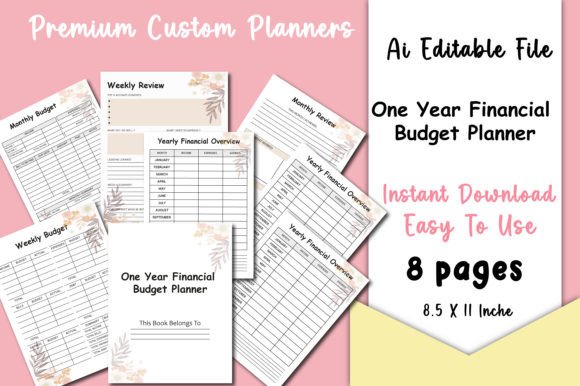
This isn’t a generic notebook or a bloated spreadsheet. It’s an 8.5″ x 11″, 8-page PDF interior file built specifically for Kindle Direct Publishing (KDP) creators and end users who value clean design and functional simplicity. Every page serves a purpose: monthly budget spreads, quarterly reflection prompts, annual goal alignment, and space for notes that bridge numbers and intentions.
The file is KDP-tested—meaning it meets Amazon’s technical requirements for bleed-free, CMYK color formatting and print-ready margins. It’s also AI-editable, so designers, educators, or small business owners can personalize fonts, headers, or branding elements without needing advanced design tools. No hidden layers, no compatibility surprises—just a straightforward, professional-grade interior ready for upload or personal use.
Why Now? Shifting Habits Around Personal Finance
More people are moving away from reactive money management—checking balances only when something feels “off”—and toward proactive, scheduled review habits. That shift mirrors broader lifestyle changes: remote work has blurred the lines between personal and professional time, making intentional scheduling essential. Freelancers juggle fluctuating income streams. Educators and creators manage side projects alongside full-time roles. Small business owners need quick, reliable ways to separate personal and operational finances—especially during tax season.
At the same time, digital fatigue is real. Many users report abandoning budgeting apps after weeks—not because they lack features, but because they demand constant input, notifications, and syncing across devices. A physical or printed planner offers cognitive breathing room: no login, no updates, no battery life to monitor. You open it, write, reflect, and close it. That tactile rhythm supports retention and reduces decision fatigue.
Designed for Real Workflows, Not Idealized Ones
A common pain point with budget tools is misalignment with how people actually operate. Some planners assume fixed paydays. Others overload pages with categories that rarely apply—like “yacht maintenance” or “luxury travel fund.” The One Year Financial Budget Planner KDP avoids that by focusing on flexibility within structure.
Each monthly spread includes dedicated rows for variable income (freelance gigs, royalties, seasonal bonuses), recurring essentials (rent, insurance, subscriptions), and discretionary spending—with room to add or rename categories as needed. There’s no forced “zero-based” pressure. Instead, there’s space to note *why* a category overspent (“unexpected vet bill”) or underspent (“canceled unused app subscription”), turning data into insight.
For creators selling on KDP, this interior also functions as a low-risk entry point into financial literacy products. With rising interest in self-publishing tools, productivity aids, and wellness-adjacent planners, a well-formatted, technically sound budget planner fills a quiet but growing niche—one that attracts repeat buyers and builds long-term brand trust.
How Professionals and Creators Are Using It
Freelancers use the quarterly review pages to compare actual income against projected earnings—then adjust pricing or outreach strategies before gaps widen. One graphic designer shared how she color-codes her monthly entries by client type (retainer vs. project-based), helping her spot imbalances before renewal season.
Educators incorporate the planner into financial literacy units, printing individual pages for classroom exercises on cash flow, needs vs. wants, or goal-based saving. Because it’s editable, they insert local cost-of-living examples—like average rent in their city or public transit passes—making abstract concepts concrete.
Small business owners repurpose the annual summary page to benchmark personal expenses against business profit distributions. One bakery owner tracks her household budget alongside quarterly net profits, ensuring personal withdrawals stay aligned with sustainable growth—not just short-term cash flow spikes.
Technical Thoughtfulness Behind the Simplicity
Every design choice reflects real-world publishing constraints and user expectations. The absence of a bleed area means no risk of critical text being cut off during KDP’s automated trimming process. CMYK color mode ensures accurate print reproduction—no surprise shifts from screen to paper, especially important for subtle grays or brand-aligned accents.
The 8.5″ x 11″ size strikes a practical balance: large enough for comfortable writing and clear layouts, yet compatible with standard home printers and binding options. At just eight pages, it avoids bloat while covering the full fiscal year—no filler, no redundant templates. That lean format lowers production cost and improves conversion rates for sellers: buyers see immediate value without scrolling past five versions of the same expense tracker.
More Than Tracking—It’s About Agency
Budgeting often carries emotional weight. For many, it’s tied to past scarcity, family messages about money, or fear of failure. The One Year Financial Budget Planner KDP sidesteps shame-based framing. There are no “good spender/bad spender” labels. No judgmental icons or red warning boxes. Instead, gentle prompts invite reflection: “What surprised you this month?” “What’s one small win you’d like to carry forward?”
That tone matters—especially for creators building audiences around wellness, education, or empowerment. When your product respects users’ autonomy and emotional context, it earns deeper engagement than any feature list ever could.
Practical Next Steps—Whether You’re Buying or Creating
If you’re considering using this planner:
- Start small. Don’t try to fill every page on January 1st. Begin with one month, then revisit the quarterly summary before adding new categories.
- Pair it with action. Use the annual goal section to name one financial priority for the year—e.g., “Build a $1,000 emergency buffer” or “Review all subscriptions by March.” Then schedule a 15-minute calendar block each month to update and assess.
- Keep it visible. Place it where you’ll see it regularly—next to your coffee maker, on your desk, or clipped to a bulletin board—not buried in a drawer.
If you’re a creator or designer:
- Test the editable layers in your preferred design software (Adobe Illustrator, Affinity Designer, or even Canva Pro with PDF import). Confirm fonts reflow cleanly and color swatches remain consistent.
- Consider bundling it with complementary interiors—like a debt payoff tracker or a simple income ledger—to increase perceived value without overcomplicating the core product.
- Use clear, benefit-driven language in your KDP description: “KDP-tested layout,” “CMYK-ready for accurate printing,” “editable for branding or classroom customization”—not just “professional design.”
Looking Ahead—Without Overpromising
There’s no indication that digital finance tools will disappear. But there’s growing evidence that hybrid approaches—digital for automation, analog for reflection—are becoming the norm. The One Year Financial Budget Planner KDP sits comfortably in that middle ground: technically precise enough for professional publishing, human-centered enough for everyday use.
As more creators enter the KDP space—not just with novels, but with tools that support real-life skills—the bar for quality rises. Buyers notice when a file is truly tested, not just uploaded. They appreciate when a planner respects their time, their goals, and their learning style. That attention to detail—whether in CMYK fidelity or thoughtful prompt wording—is what turns a functional download into a trusted resource.
And if you’re already using this planner? Try highlighting one insight from your first completed month—not a number, but a pattern. Maybe it’s how often you eat out when working from home, or how much you spend on learning resources versus entertainment. That single observation, written down and revisited, is where meaningful change begins.