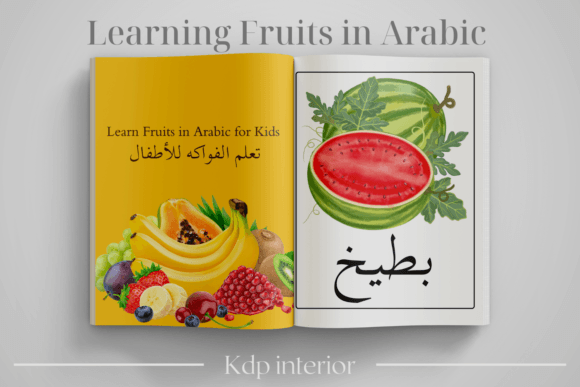
Fruits in Arabic for Kids Flashcard: A Practical Resource for Early Language Exposure
Teaching young children Arabic through everyday themes like food offers a natural, low-pressure entry point into language learning. The Fruits in Arabic for Kids Flashcard is a 24-page educational resource designed specifically for PreK–2nd grade learners. It centers on fruit vocabulary—presenting each item with a clear image, its name in Arabic script (with vowel marks where helpful), and an English translation. Unlike broad language curricula or digital apps that may overwhelm early learners, this resource focuses tightly on one thematic category, supporting repetition, visual association, and tactile interaction.
What Sets This Resource Apart
The Fruits in Arabic for Kids Flashcard distinguishes itself through intentional design choices aligned with early childhood development principles. Its flashcards are sized for small hands, feature uncluttered layouts, and use high-contrast, realistic fruit photography—not cartoonish illustrations—that support accurate recognition and real-world transfer. Each card includes the Arabic word written right-to-left with proper diacritics (e.g., تِينٌ for “fig”), offering scaffolding for pronunciation without assuming prior knowledge of Arabic phonology.
The accompanying posters reinforce learning visually and spatially. Mounted on a classroom wall or used during circle time, they serve as passive exposure tools—especially valuable for dual-language programs where consistent environmental print supports literacy development. At 24 pages, the set strikes a balance between comprehensiveness and manageability: it covers 18 common fruits (apple, banana, orange, dates, pomegranate, etc.), enough to build foundational vocabulary without diluting focus.
How It Compares With Other Approaches
When evaluating resources for introducing Arabic to young children, educators and caregivers often weigh formats like physical flashcards, digital apps, storybooks, or teacher-led worksheets. The Fruits in Arabic for Kids Flashcard occupies a distinct niche: it’s tactile, screen-free, and curriculum-light—meaning it doesn’t require lesson planning or tech setup, yet still delivers structured input.
Digital tools may offer audio pronunciation or gamified quizzes, but research suggests young children benefit more from concrete, manipulative materials that encourage movement, sorting, matching, and verbal rehearsal. Flashcards also allow for differentiation: a child ready for writing practice can trace letters on laminated cards; another might start by pointing and naming. In contrast, many bilingual picture books introduce vocabulary incidentally—useful for immersion, but less effective for targeted vocabulary acquisition unless paired with explicit instruction.
Compared to generic Arabic flashcard sets, this resource prioritizes relevance and cultural resonance. Fruits like dates (تَمْرٌ), figs (تِينٌ), and pomegranates (رُمَّانٌ) appear alongside apples and bananas—acknowledging both global availability and regional significance. That subtle inclusion supports identity development for Arabic-speaking children while expanding cultural awareness for others.
Strengths Worth Considering
- Developmentally appropriate pacing: Introduces vocabulary in manageable chunks, avoiding cognitive overload.
- Bilingual clarity: Arabic text appears in standard Modern Standard Arabic (MSA), not dialectal forms—ideal for formal instruction and consistency across classrooms.
- Print quality and durability: Designed for repeated handling, with recommendations for lamination included in usage notes.
- Flexibility in implementation: Works equally well in homeschool settings, preschools, after-school Arabic programs, or as supplemental material in general education classrooms.
Tradeoffs and Limitations
No single resource meets every need—and understanding its boundaries helps guide realistic expectations. The Fruits in Arabic for Kids Flashcard does not include audio files, so teachers or parents must supply pronunciation modeling. While vowel marks aid beginners, it doesn’t teach the Arabic alphabet or reading rules; it assumes some adult support or prior familiarity with basic letter sounds.
It also lacks built-in assessment tools or progress tracking—unlike some digital platforms that generate reports or adapt difficulty. For educators needing formal documentation of student growth, this would need to be supplemented with observation checklists or simple oral assessments.
Additionally, the scope is intentionally narrow. If your goal is broader thematic coverage—vegetables, animals, colors—the Fruits in Arabic for Kids Flashcard serves best as one unit within a larger sequence, not a standalone solution.
When This Resource Fits Best
This set shines in contexts where simplicity, consistency, and sensory engagement matter most. Consider it if you’re:
- Introducing Arabic as a second language in a PreK or kindergarten setting with limited instructional time per week;
- Supporting heritage language maintenance at home, especially when caregivers aren’t fluent but want to provide authentic materials;
- Designing a thematic unit around food, health, or seasons—and need reliable, ready-to-use visuals;
- Working with mixed-ability groups and need a tool that allows for varied participation (e.g., pointing, naming, matching, sorting by color or size);
- Seeking screen-free alternatives that still promote active language use rather than passive viewing.
One practical example: A bilingual preschool teacher uses the posters during morning meeting, naming three fruits daily and inviting students to find them in the room or bring related items from home. Later, students match flashcards to real fruit samples or sort them by color—reinforcing vocabulary through multiple modalities.
When You Might Look Elsewhere
If your priority is independent practice for older children (grades 3+), you’ll likely need resources with sentence-level context, grammar notes, or interactive exercises—none of which the Fruits in Arabic for Kids Flashcard provides. Similarly, if you’re teaching a specific dialect (e.g., Egyptian or Levantine Arabic), this MSA-based resource won’t reflect colloquial terms like “mawz” (Egyptian for banana) instead of “mawzah” (MSA).
For families seeking immersive storytelling, a leveled reader series with repetitive phrases and narrative structure may offer richer language exposure than isolated vocabulary cards. And if accessibility is central—for example, for learners with visual processing challenges—resources with textured elements, braille overlays, or audio integration would better meet those needs.
Making an Informed Choice
Evaluating the Fruits in Arabic for Kids Flashcard isn’t about finding the “best” product—it’s about identifying whether its design aligns with your goals, setting, and learners’ needs. Its value lies in fidelity to early learning principles: visual clarity, repetition, physical interaction, and thematic coherence. It doesn’t try to do everything, and that restraint is part of its strength.
Before purchasing, ask: Will this be used regularly—or sit on a shelf? Does it complement existing routines, or add complexity? Can adults involved confidently model pronunciation, or will that require additional preparation? These questions matter more than feature lists alone.
In sum, the Fruits in Arabic for Kids Flashcard is a grounded, classroom-tested option for educators and caregivers who value intentionality over novelty—and who understand that meaningful language learning begins not with complexity, but with clarity, consistency, and connection.