Pencil Control Activity Book for Kids: Build Strong Foundations, One Line at a Time
Every child’s journey to confident writing begins long before they form their first full sentence. It starts with the quiet focus of guiding a pencil along a wavy line, carefully tracing the curve of an “S,” or copying the shape of a smiling elephant. That’s where the Pencil Control Activity Book for Kids steps in—not as just another workbook, but as a thoughtfully designed toolkit for early development.
Why Pencil Control Matters More Than You Might Think
It’s easy to overlook pencil control as a “pre-step” to real learning. But research and classroom experience consistently show that strong fine motor coordination directly supports academic readiness. Children who struggle to hold a pencil correctly or apply consistent pressure often face avoidable hurdles in kindergarten and beyond—slower work pace, fatigue during writing tasks, even frustration that spills into other subjects.
The Pencil Control Activity Book for Kids tackles this head-on—not through drills or repetition alone, but by embedding skill-building inside joyful, meaningful practice. Each page invites engagement: tracing letters isn’t just about shape—it’s about preparing for spelling and phonics. Tracing animals sparks curiosity about names, sounds, and habitats. Number tracing (1–10) builds number recognition *and* reinforces one-to-one correspondence—all while strengthening finger dexterity.
What’s Inside the Book? More Than Just Lines to Follow
This isn’t a generic tracing workbook. Every element serves a developmental purpose—and every detail reflects intentional design:
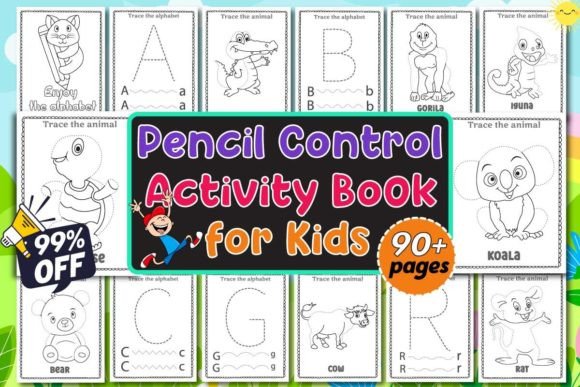
- Alphabet Tracing Pages: Uppercase and lowercase letters appear in clear, developmentally appropriate fonts—with starting dots and directional arrows to guide proper formation. Letters are grouped by similar strokes (e.g., “c,” “o,” “a”) to reinforce muscle memory.
- Animal Tracing Activity: From owls to octopuses, each animal is drawn with bold, flowing outlines that encourage smooth wrist movement—not just finger motion. Kids aren’t just copying shapes; they’re building visual discrimination and narrative connection (“Look—the fox has a bushy tail!”).
- Number 1–10 Tracing: Numbers are paired with corresponding quantities (e.g., three stars beside “3”) and simple icons (like apples or bees), linking symbol to meaning. Arrows and shaded guides support consistent sizing and spacing—key for future math notation.
- Premium Quality Interior Design: Crisp lines, generous spacing, and high-contrast visuals reduce visual clutter—critical for young eyes still refining tracking ability. No overcrowded pages. No confusing layouts. Just clean, supportive structure.
Fine Motor Skills: The Hidden Engine Behind Learning
Fine motor skills involve the small muscles of the hands and fingers—and they power far more than handwriting. Zipping a coat, using scissors, buttoning a shirt, even typing later on—all rely on the same foundational control nurtured by tracing activities.
In the Pencil Control Activity Book for Kids, fine motor development happens organically. When a child traces a zigzag path around a lion’s mane, they’re coordinating thumb-index-middle finger movement, adjusting grip pressure, and sustaining attention. When they loop around the outline of a turtle shell, they’re practicing controlled rotation—a precursor to cursive writing.
Parents and educators often notice subtle but powerful shifts after consistent use: pencils held higher on the shaft (not clenched in a fist), smoother transitions between strokes, increased willingness to attempt new words or numbers without prompting.
Hand-Eye Coordination: Where Vision Meets Movement
Hand-eye coordination isn’t just about catching a ball. It’s the invisible bridge between what the eyes see and what the hand does. In early learning, it shows up when a child matches a dot to its pair, follows a dotted path from start to finish, or copies a shape placed beside their worksheet.
The Pencil Control Activity Book for Kids strengthens this bridge deliberately. Animal tracing pages include subtle background details (like grass lines or cloud shapes) that invite scanning and selective focus. Alphabet pages vary line thickness and direction—curves, diagonals, horizontals—to challenge visual tracking across planes. Even the consistent 8.5×11″ size offers ample space for movement without overwhelming the child’s visual field.
Pre-Writing Skills: Laying the Groundwork for School Success
“Pre-writing” isn’t a placeholder stage—it’s active preparation. It includes developing pencil grasp, understanding spatial concepts (top/bottom, left/right), recognizing letter orientation, and building stamina for sustained effort.
This book supports all of those quietly. For example:
- Starting dots and arrow cues teach directional consistency—so “b” doesn’t accidentally become “q.”
- Wide-ruled spacing prevents cramped letters and models proper baseline alignment.
- Progressive difficulty—from thick guided lines to thinner outlines—builds confidence incrementally.
Teachers report that children who’ve used structured tracing resources like the Pencil Control Activity Book for Kids transition more smoothly into formal handwriting instruction. They arrive with stronger muscle memory, clearer visual models, and less anxiety about the physical act of writing.
Designed for Real Life: Print-Ready Files You Can Use Immediately
Whether you're a parent printing at home, a homeschool educator assembling a curriculum kit, or a small business owner creating custom learning bundles—the Pencil Control Activity Book for Kids delivers flexibility without compromise.
All interior files come in four industry-standard formats:
- PDF: Perfect for quick home printing—crisp, reliable, no software needed.
- JPG: Ideal for digital learning platforms or projecting onto smartboards during group lessons.
- AI & EPS: Scalable vector files for designers, print shops, or creators who want to customize covers, add branding, or adapt pages for specific learners (e.g., high-contrast versions for visual needs).
No waiting. No compatibility headaches. Just open, print, and go—whether it’s for morning warm-ups, occupational therapy sessions, or rainy-day screen-free play.
Who Benefits Most—and How to Get Started
This book shines for children ages 3 to 6—but its value extends beyond age labels. It’s especially helpful for:
- Preschoolers building early literacy foundations;
- Kindergarteners needing extra reinforcement before standardized assessments;
- Children with sensory processing differences who benefit from predictable, structured motor input;
- Homeschool families seeking affordable, printable resources aligned with developmental milestones;
- Therapists and tutors looking for evidence-informed, engaging materials to supplement sessions.
Start small: two to three pages per day, five minutes max. Let your child choose the animal or letter they love most. Celebrate effort—not perfection. Keep a favorite pencil nearby (a short, triangular pencil or pencil grip can make a big difference). And remember—every line traced is a neuron connecting, a muscle remembering, a confidence growing.
The Pencil Control Activity Book for Kids doesn’t promise overnight mastery. What it delivers is something deeper: steady, joyful progress—one thoughtful stroke at a time.